
Saudi Arabia, Turkey, and Pakistan: The Power Triangle Redefining Regional Balance
By Dr. Saleh bin Bakker Al-Tayyar
President of the Arab-European Center for Studies, Paris
This article was translated using artificial intelligence and the original language of the article is Arabic.
In a world where power dynamics are shifting rapidly, alliances are no longer built on slogans or measured by a flood of transient statements and positions. Instead, they are defined by a nation’s capacity to build genuine partnerships rooted in mutual interest, shared trust, and the ability to safeguard security, ensure stability, and shape the future.
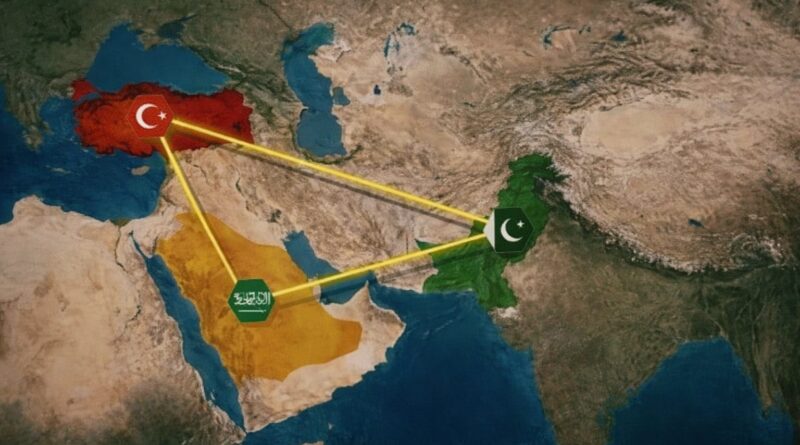
From this perspective, the Kingdom of Saudi Arabia, Turkey, and Pakistan emerge as pivotal regional powers. Each possesses distinct political, economic, and strategic assets, while their convergence and joint coordination grant them broader leverage to influence outcomes and establish equilibrium in a highly sensitive and complex region.
Riyadh: The Center of Gravity
The Kingdom of Saudi Arabia no longer approaches its regional role from a reactive posture, but from the position of a state equipped with a clear vision for both its own future and that of the region.
Since the launch of Saudi Vision 2030, the Kingdom has entered a new phase of international engagement characterized by the diversification of partnerships, economic growth, the consolidation of its political standing, and the cultivation of balanced ties with global and regional powers alike.
Herein lies the significance of the partnership with Turkey and Pakistan: it is not a temporary political expedient, but rather an alignment driven by strategic interests that intersect across economics, security, investment, defense, technology, and trade.
Ankara: An Indispensable Regional Power
Turkey holds a unique geopolitical location bridging Asia and Europe, coupled with substantial economic, military, and political weight.
The Saudi-Turkish rapprochement reflects a shared realization that the region requires partnerships capable of navigating major transitions—not closed axes or temporary alignments.
The relationship between Riyadh and Ankara transcends traditional calculations. Immense opportunities exist for economic, investment, defense, technological, and tourism cooperation, paving the way for a deeper and more impactful partnership.
Islamabad: Strategic Depth
Pakistan—with its demographic, geographical, military, and economic assets—brings crucial strategic depth to this alignment.
Saudi-Pakistani relations are deep-rooted and historical. Bilateral cooperation rests on firm foundations, making a trilateral convergence with Turkey a natural extension of shared interests in security, development, trade, and investment.
When Riyadh, Ankara, and Islamabad converge, we are not witnessing a fleeting political grouping, but rather three nations possessing real instruments of influence in their regional and international environments.
Not an Axis Against Anyone
This landscape must be interpreted intelligently.
The Saudi-Turkish-Pakistani power dynamic does not need to define itself as an alliance directed against any third party.
Indeed, its true strength lies in being a partnership tailored for shared interests, stability, balance, and development.
This marks the distinction between alliances formed as reactions to others and those built because the participating parties share a coherent vision for the future.
Riyadh does not seek adversary, Ankara does not need new conflicts, and Islamabad recognizes the necessity of balanced relations that protect its national interests.
At the same time, all three sovereign nations retain the full right to construct partnerships, enhance capabilities, and safeguard their national priorities.
Economics: The Soft Power of the Partnership
Economy is perhaps the most effective avenue for translating political rapprochement into a sustainable partnership.
Saudi Arabia boasts one of the region’s largest economies alongside massive investment and development programs. Turkey possesses a broad industrial, commercial, and tourism base. Pakistan offers a vast consumer market and a strategic location linking South Asia with its surrounding region.
Consequently, a comprehensive framework of shared interests can materialize across key sectors: investment, energy, industry, defense, technology, tourism, infrastructure, food security, and trade.
Translating these sectors into joint projects will yield an economic alliance far more durable than any political declaration.
Power Does Not Mean Escalation
A defining hallmark of modern Saudi vision is that it does not pursue influence through escalation, but rather through balanced power, active presence, and smart partnerships.
Therefore, deepening strategic ties with Turkey and Pakistan does not entail closing doors to others; rather, it signifies expanding options, diversifying relationship networks, and enhancing the capacity to navigate a multipolar world.
Smart diplomacy does not force a choice between friendship and power; it knows how to combine both.
The Region Facing a New Era
The Middle East and South Asia are undergoing extensive reconfiguration.
As traditional alliances retreat and more flexible partnerships emerge, the greatest influence will belong to states capable of constructing multi-layered relations encompassing politics, economics, security, and technology.
In this context, Saudi Arabia, Turkey, and Pakistan can present a distinct model for regional partnerships—a model not grounded in hegemony or exclusion, but in capability integration, mutual benefit, and respect for sovereignty.
The Key Message
Perhaps the clearest message of this rapprochement is that the region no longer waits for external actors to design its future.
Riyadh, Ankara, and Islamabad possess the capacity to actively shape that future.
Saudi Arabia through its political, economic, Arab, and Islamic weight; Turkey through its geopolitical, economic, and military clout; and Pakistan through its strategic depth, demographic scale, military strength, and vital geographic location.
When these assets align, the outcome is not merely a new alliance, but a renewed capacity to generate equilibrium.
In politics, real impact belongs not to those who shout the loudest, but to those who hold the broader choices, stronger partnerships, and longer visions.
Saudi Arabia, Turkey, and Pakistan do not need to proclaim their influence; their scale, interests, and geopolitical standing speak for themselves.
The coming period may prove that the most significant transformations do not always begin with high noise… but sometimes with three capitals deciding to speak the language of interests, trust, and balance.